Wednesday, May 30, 2012

Author Ethan Jones introduces new action thriller hero with Justin Hall novels

1.) Ethan, for those not familiar with your work, can you tell us something about your writing and yourself as a writer?

I write spy thrillers and have completed two novels. Arctic Wargame is the first book in Justin Hall series.  Justin, an agent with the Canadian Intelligence Service, has been demoted after a botched rescue operation in Libya. Eager to return to the field, he volunteers for a reconnaissance mission to the Arctic, after two foreign icebreakers appear in Canadian waters. His team uncovers a treasonous plan against Canada’s security and falls into an ambush by one of their own. Left for dead in the Arctic, Justin and his team must race to save themselves and their country. Arctic Wargame came out on May 22 on Amazon as an e-book and paperback.

Tripoli’s Target is the second book in Justin Hall series. Justin and his partner, Carrie O’Connor, are sent to meet with the Sheikh of the largest terrorist network in Northern Africa, to receive some high-value intelligence. They learn about an assassination plot against the U.S. president, which is to happen during a G-20 summit in Tripoli, Libya. Justin and Carrie inform the U.S. Secret Service about this plot. Then, new intelligence comes in, and they realize something is very, very wrong in their plan. Against all odds, they must stop the assassination before the summit forty-eight hours away. Tripoli’s Target is scheduled for a late fall release this year. Its prologue and first chapter are included as bonus content at the end of Arctic Wargame.

Two of my short stories are also available on Amazon.  The first one, "Carved in Memory," is a prequel to Arctic Wargame and explains an important aspect of Justin’s background. The second one, "The Last Confession," is about a dying NY mobster confession to his priest.

2.)  Ethan, as your website states, you are a lawyer by trade. It seems to me a number of lawyers have become well-known authors over the years, Coonts and Grisham being two of the most obvious, so I have to wonder how that particular career has driven so many lawyers to become writers. How has being an attorney impacted your own writing?

There is a lot of writing and reading involved in the work of a lawyer. Memos, briefing notes, witnesses reports, opening and closing statements. A lot of research goes into preparing for a case, whether it ends up in court or not. The legal research sharpens one’s mind, as everything needs to be persuasive and concise. These skills are extremely helpful when writing a fictional novel.

3.) What do your novels bring to readers that is unique?

My stories feature Canadian secret agents and there aren’t that many of them in the fictional world, although Canada has a strong presence in the international intelligence community.  The plots and the storylines take the reader to places they are unable to go or it wouldn’t be advisable to visit. I hope the readers find my novels entertaining and will want to read more.

4.) Since you write espionage thrillers with links to Canada, what kind of research have you done? For instance, have you had contact with the Canadian Security Intelligence Service?

I have read a lot of CSIS reports and double-checked the facts of my story. Of course, I have made full use of my creative license, but I have tried my best to give the reader as much truthful information and a plausible storyline. I have made good use of internet sources, as well as other media. I have also talked to some CSIS agents.

5.) What is your favorite sport? Why?

I like to play tennis. It exercises all the muscles of your body and it sharpens your reflex skills. Also, one needs only one partner to play it.

6.) You are sitting in your office one day when a well-dressed man comes in, sits down across from you, removes a pistol from beneath his jacket and places it on your desk within easy reach of himself but not quite within your own range. "I have a story to tell," he says. What is your response?

My response will be: I’ll cancel all my meetings for today.

Ethan adds:

I would love readers' feedback.  They can get in touch with my via e-mail. I promise to write to each and every one of them.

My blog is the place to learn about my future works, to enjoy exclusive book reviews and author interviews.

I'm also on Facebook.

The Amazon page for Arctic Wargame.


As an added bonus, here is an excerpt from Arctic Wargame:

PROLOGUE

Ghadames, Libya
Six months ago
October 10, 3:00 a.m.

The sand dunes sank into darkness as a curtain of clouds dimmed the glow of the crescent moon. Justin limped closer to the small barred window of his prison cell. His bruised chest pressed against the rough surface of the bloodstained wall. He squinted and tried to stand on his toes for a better look. The rusty shackles clawed against the scarred skin of his ankles, and the heavy chain rattled on the cement floor.

“Quiet. Be quiet, you bastard infidel,” a guard growled in Arabic from down the shadowy prison hallway.
Justin stood still and drew in a deep breath, the cold night air of the Sahara desert filling his heaving lungs. Everything went silent again. No rapid steps rushing to his cell. No swearing bellowed by other inmates. He lifted his head, wrapped his free hands around the iron bars, and clenched his teeth, ignoring the jolts of pain from his fingers. With his eyes about an inch over the windowsill, Justin scoped the landscape, searching for the long-awaited rescue team.

Abdul, his connection within Libya’s Internal Security Agency who lay in the cell next door, had confirmed their escape was to take place early that morning. Their previous attempt the night before had failed, despite the inside help of one of the terrorists. Justin hoped this time their plan would be executed with no glitches.

At first, he noticed nothing except the rugged outlines of the steep dunes and the whitewashed walls of the sleepy town. Straining his eyes, he peered again. A small shadow slithered toward the prison wall. Justin blinked to clear his vision and stared at the approaching figure.

Bent at the waist, the shadow advanced at a rapid pace. It quickly disappeared from his sight, and he wondered whether the man had encountered a guard.

Justin’s heart pounded. He placed his ear to the wall and sensed a low grating noise. Someone, the shadow he hoped, was scaling the wall.

The window was at least twelve feet above the ground. He wondered how long it would take the shadow to reach it. A long minute dragged by and Justin was still alone. He breathed faster and faster and urged the man on the freedom side of the wall to make good time.

Finally, a hushed voice whispered in Arabic, “Abdul, Abdul, it’s me, Bashir. You there?”

“I’m Justin,” he replied softly.

“You’re the Canadian agent. Where’s Abdul?”

“In the other cell, around the corner, but that one has no window.”

“When did they move him?”

“A few hours ago, after they gave him a good beating.”

“Can he walk?”

“I think so.”

Bashir went silent for a moment. Justin looked up, but could not see the man’s face through the window. He asked slowly, “Bashir?”

“Shhhh.”

A few seconds later, he heard a scraping sound. Bashir was offering him a large metal key through the window bars. “That’s for the shackles,” Bashir said under his breath, “and this is for the guard.” He produced a black dagger.

Justin grabbed the handle and weighed the weapon in his weak hand. A ray of moonlight glinted off the ten-inch blade.

“Can you do this?” Bashir whispered.

“Yes.”

“You have only one chance. I’ll wait for you and Abdul in two black Nissans by the main gate. Then we’ll drive across the border to Tunisia.”

Justin frowned. “What about the hostages? The two Canadian doctors?”

“The Algerians moved them from their safe house to another location, out of the prison but still in town. My men are on their way there.”

“And Carrie?”

“Yes, your partner is with them.”

Justin breathed a sigh of relief. “OK. I’ll make sure Abdul and I meet you by the gate.”

“You’ll have to be quiet. About twenty men are guarding the prison, and we can’t defeat them all.”

“OK.”

“Abdul knows the way, but if you can’t free him, walk down the stairs and go left. The hall will take you to a small courtyard on the ground floor. There will be a guard or two by the gate. You need to cross into the house next door.”

“Downstairs, then left, then to the house,” Justin said, finding it a bit difficult to concentrate on Bashir’s words.

“Yes. Get to the roof of the house and drop down along the side facing the mosque. Follow the road leading to the main gate. Is it clear?”

“Yes, it is.”

Bashir’s clothes rubbed against the wall, and then silence returned to Justin’s cell. He stared at the key and the dagger in his right hand. Stepping back from the window, he was careful not to jerk the chain and alert the guard beyond the solid metal door. The key fit into the shackles’ padlock. He coughed loudly as he turned the key to cover the dull clunk of the lock snapping open. Now almost free, he removed the metal loops from around his ankles.

First imprisoned in Tripoli after their hostage rescue operation went wrong, Justin and Abdul were subjected to torture by the Algerian hostage takers for two days. After Justin and Abdul attempted an escape and killed a guard in the process, the Algerians––with the help of the Libyan secret police––moved them to Ghadames, an isolated and less risky place in their minds.

Justin wasted no time. He took a deep breath, gripped the dagger tightly, and called out to the guard, “Hey, open the door.”

“Shut up,” the guard roared back.

“I need to talk to you.”

“No. Just shut up.”

Justin banged twice on the heavy door.

The guard’s voice grew louder as he drew nearer to the door. “What’s the matter with you? You want me to break your leg?”

Justin slammed his fist against the door.

“That’s it. You asked for it,” the guard shouted.

Keys clattered as the guard struggled to find the right one to unlock the door. Justin stepped to the side and lifted his dagger high, waiting for the right moment. His hand shook. The weapon felt heavy, straining his muscles.

“I’m going to beat some sense into you now,” the guard barked.

As the guard shoved open the door, Justin thrust his hand toward the man’s throat. The blade slashed deep under the man’s thick chin, severing his windpipe. The guard dropped dead into his stretched arms, blood sputtering from the man’s mangled neck.

Justin used the guard’s black robe and turban to wipe the blood stains from his face and his arms. He stripped the man of his keys, his side arm—an old Beretta 92 pistol—his AK-47 assault rifle and two magazines. Justin dragged the body to a corner of his cell and locked the door behind him.

He tiptoed to Abdul’s cell. On the second try, he found the right key. As he opened the door, the powerful stench of sweat and urine almost twisted his stomach inside out. Abdul was lying against a wall, asleep.

“Abdul, Abdul, wake up.” Justin rustled him.

“Huh? What?” Abdul mumbled with a big yawn.

“Time to go, man.”

“Justin, how did you…” Abdul sat up slowly and stared into Justin’s eyes.

“Bashir gave me a key and a knife.”

“Bashir? When did he come?”

“Tell you later. Let’s go. Can you walk?”

“Yes, yes, I can.”

Justin unchained Abdul’s bruised legs and helped him to his feet. Abdul leaned against the wall before taking a few unsteady steps.

“I’m good. I can do this,” Abdul said.

“OK, follow me.”

“First, give me that.” Abdul pointed at the assault rifle.

“Bashir said we need to break out in silence. Too many fighters for us to kill them all.”

Abdul held the AK-47 in his hands with difficulty and fumbled with the safety switch. Finally, he switched it to full automatic. “Just in case,” he mumbled.

“Let’s go.”

Justin threw a glance down the hall and signaled for Abdul to follow him. They moved quickly to the end of the narrow hallway, their bare feet tapping lightly on the concrete floor, grains of sand gritting their toes.
“We go to the first floor, then left,” Justin said as they came to a spiral staircase.

“Then what?”

“Left through the hall until we reach the courtyard. We have to go through the door taking us to the house next to the prison. Bashir will wait for us at the main gate.”

“What? That’s Bashir’s plan? There’s always a group of guards in the back.”

“He said there should be only one, two at the most, and we have to get rid of them quietly.”

“That’s impossible. They’ll see us as we go outside and kill us.”

“Maybe they’re dozing off.”

“If not, we shoot first.”

“No. We’ll have the rest of the Algerians coming after us.”

Justin winced as his left foot landed on the coarse surface of the first stair. He took two more steps and turned his head. Abdul nodded and followed behind him. Holding the dagger ready in his hand, Justin continued down the stairs. He reached the bottom. The hall forked right and left. A light flickered from the right. Justin stepped back, gesturing for Abdul to stop.

“What’s that way?” Justin asked in a hushed tone, pointing toward the light.

“A kitchen and a dining area. And someone’s awake.”

“Don’t worry about it. We’re slipping out the other way.”

Justin glimpsed again toward the dim light, then to the opposite side and began creeping down the hall. He saw a door about twenty steps ahead and figured it was the one opening into the courtyard. Pressing on, he quickened his pace. Abdul’s feet shuffled loudly behind him.

“Quiet, quiet, Abdul,” he said.

“That’s not me.”

Justin turned his head and looked over Abdul’s shoulders. He stared right into the eyes of a man standing five or six steps behind Abdul and pointing a pistol at them. The gunman was of a small, thin stature, clad in a white robe and a black headdress.

“Stop or I’ll blow your head off,” he said in Arabic.

The gunman’s voice crackled abruptly. Its unexpected high pitch startled Justin. The pistol shook in the young man’s hands.

“He’s just a kid,” Justin whispered to Abdul, who was preparing to turn his rifle toward the gunman.

“I will shoot you,” the young man squeaked, this time louder. “You, turn around with your hands in the air,” he ordered Abdul.

Abdul swung on his heels, firing a quick burst.

“No,” Justin shouted.

Bullets went through the gunman. Two large purple stains appeared on his chest as he collapsed over a chair.

“No, no, no,” Justin cried. “He was a kid, just a kid.”

“Who was going to blow our heads off,” Abdul replied.

“We could have talked to him.”

Abdul shook his head. “No time for talk. Now run.”

Before Justin could say anything, someone kicked open the door behind him.

“Down,” Abdul shouted and pointed his AK-47 toward the door.

Justin fell to the floor, while Abdul kept his finger on the assault rifle’s trigger. Bullets pierced the bodies of two guards who entered the hall. Loud cries and barking orders came from two stories above. Rapid thuds of heavy boots echoed throughout the prison. Justin pulled out the Beretta from a pocket of his tattered khakis. As soon as two men running downstairs entered his sights, he planted a couple of bullets in each man’s neck.

“Go, go, go. Move, move!” he yelled at Abdul.

Abdul checked the door and fired a short burst into the courtyard. A few shrieks confirmed he hit his mark, and he dove outside. More gunfire followed. The reports of assault rifles echoed in the night. Heavy machine guns hammering in the distance pounded the urgency of their escape into the Canadian agent. After trading his Beretta for a high-powered AK-47 next to the body of a dead guard, Justin joined Abdul in the courtyard.

Books read in 2012: No. 49 -- Gladly the Cross-Eyed Bear

by Ed McBain

Started: May 28
Finished: May 31

Notes: Though I'm a big fan of McBain's 87th Precinct novels I've only read one other of his Matt Hope series. This will be the second. I was slightly disappointed with the first Matthew Hope novel I read, Mary, Mary, because it didn't have the hard-boiled edge McBain's earlier police procedural novels contained. However, Mary, Mary was still a decent read, so I thought I'd give another novel in this series a try.

Mini review: My impression remains the same concerning the Matt Hope series. The writing isn't bad, and I've read enough to see how McBain is putting these stories together, put legal dramas just aren't my thing. So, for the most part I'll be sticking with McBain's police procedurals.

Books read in 2012: No. 48 -- On the Good, Red Road

by Blake Crouch

Started: May 28
Finished: May 28

Notes: This author has a number of thriller/horror novels that are of interest to me, but I've put off reading his material for some time simply because there is so much to read. No more. Up until now I've only read one short work he did with Joe Konrath a couple of years ago, so it's time I read some of Blake's solo work.

Mini review: An excellent short story mixing non-supernatural horror with the Western genre. I believe, though I'm not positive, this short tale is actually a prologue or perhaps first chapter of a longer work, the novel Abandon, which I've been wanting to check out. This only whetted my appetite.

Monday, May 28, 2012

Fantasy author Scott Fitzgerald Gray interviewed


1.) For those who don't know, Scott, can you tell us a little about your writing and your path to becoming a writer?

I've been writing professionally (as in, miraculously getting paid for it) since the mid-90s, mostly working as a screenwriter in Canada, but mostly doing "real work" on the side to make ends meet. I abandoned the last of the real jobs in about 2002, at about the same time I backed off from screenwriting and started to focus more on novels, which is what I'd always wanted to be doing while I was screenwriting. I love fiction and narrative in just about any form, but as a writer, I'm drawn first and foremost to speculative fiction and fantasy built around a solid core of character story. I like the challenge of making fantastic worlds and making characters resonate with the core experience of being alive -- applying to fantasy and speculative fiction what William Faulkner famously called "the human heart in conflict with itself."

My creative work never followed anything like a conscious career path, but in the course of accidentally tripping into opportunities at different times, I've managed to accidentally become the writer I'd tried and failed to be early on. Like a lot of people, I had dreams of being a novelist in my 20s, only to discover that though I had some serious skill as a wordsmith at that age, I had no idea how to tell a story or even what stories I wanted to tell. I got into film essentially by accident at about that time, and stayed there because I was making money at it. But in the course of working constantly to make myself a better screenwriter, I was surprised to realize that I'd managed to teach myself a certain mastery of story structure and narrative. I was then able to turn that understanding toward prose fiction, and I haven't looked back.

2.) Besides fiction, you also work freelance for the gaming industry. What relation is there between gaming and fiction writing? Or is there one?

The obvious answer is imagination, though that point's been made by people smarter than me. More specifically, although the "stories" told in the course of roleplaying gaming are very different than "real" fiction, the narrative lessons of fiction and gaming have strong internal connections. For me, one of the most important lessons one can draw from gaming is the idea that what makes a story memorable is what makes it personal. Gaming is a fictional enterprise in which everything has meaning to the "reader" because the reader is one of the collective writers of the story. And this reminds us that the best fiction (and specifically the best fantasy and speculative fiction) is that which allows the reader to draw meaning from a narrative regardless of how far removed that narrative might be from real life.

3.) What are your future writing plans?

To dig into the large number of books that have been building up in my mind and on my hard drive as notes and ideas demanding to be brought to life. I'm just finishing a final proof on a semi-autobiographical contemporary-SF teenage-gamer coming-of-age novel (We Can Be Heroes) that'll be out this month, after which it's back to more of the epic fantasy that accounts for most of what I've written over the last few years. The followup to my novel Clearwater Dawn (book two of three, titled Three Coins for Confession) is next up, but I'm also trying to keep active writing short fiction at the same time that I focus on the longer works.

My writer's mind works in ways that lend themselves to Big Story, such that I often find it easier to outline and play around with longer works than to dig in with the brevity and focus needed to write a really good short story. I'm a firm believer that as writers, we need to constantly challenge ourselves, and that not simply falling back on what we're comfortably good at is the best way to do that. (Feeling like the challenge was flagging is a large part of why I moved away from screenwriting, though I still work a lot as a story editor on other people's scripts and film projects.) Because I find it difficult to write short fiction, every short story I write teaches me something new about my process and makes me a better writer.

4.) Beer or wine? Or something else?

Coke Zero in unhealthy quantities.

5.) Which is your favorite of the Three Stooges? And why?

Moe, because he's an evil genius and i've always aspired to that job.

6.) You wake to find yourself on a deserted island. You have on and with you whatever you have at the moment of reading this. What do you do?

If "on and with you" implies being able to grab hold of the laptop before teleporting away, I'd try to find a power outlet and keep working. After struggling for a number of years to get to the point where I can write anything and everything that I want to write, I now have a lot of stories to get caught up on. However, assuming it's just a clothes-on-my-back kind of scenario, probably the only thing I'd be able to do is starve to death in short order. I know how to catch and clean a fish, but that's about the extent of my wilderness survival skills.

For more about Scott Fitzgerald Gray, check out his ...
Website: Insane Angel Studios
Amazon page
Smashwords page

Sunday, May 27, 2012

Books read in 2012: No. 47 -- The Butcher's Boy

by Michael Robb Mathias

Started: May 25
Finished: May 28

Notes: I've been on a streak of reading dark novels with a mixture of horror, thriller and paranormal fantasy elements of late, and this one fits the bill. Besides, I've been meaning to read more of this author and here is my opportunity.

Mini review: I have to say, if Mathias can write horror like this, I believe I prefer it over his fantasy work. Not that his fantasy is bad, and honestly I've not read enough of it yet to make any real decisions, but The Butcher's Boy was a pretty strong read. Yeah, sure, like anything it has some things I could pick it, but it had strong characters and a fairly strong plot.

Saturday, May 26, 2012

100 Years of Blood: A novel for those who want to think for themselves


My latest novel, 100 Years of Blood, has raised some questions for myself and from a few of my readers.

What genre is the novel?

That seems to be the big question. I'm not sure I have a good answer.

The plot revolves around an elaborate house built by an English gentleman in the hills of Appalachia during the early part of the 20th Century. The reader follows the events of the house for a hundred years. Many important events happen outside of our away from the immediate environs of the house, and such events are only hinted at. Thus, much is left unsaid, at least directly.

Some of the characters themselves are a bit mysterious, showing hints they might be more than they seem. Or are they?

The questions this novel raises is one of the reasons it is difficult to give it a specific genre label. I write mostly in the speculative genres, fantasy and horror mainly, so there's an urge to label 100 Years of Blood as fantasy. But then the possible fantastic elements of the story are only hinted at and for the most part don't seem to play a direct role in the overall tale, leaning towards this novel being magical realism or some form of literary novel.

I will admit, yes, as the author, I could give direct answers. I could say, "yes, this is a magical realism novel," or something similar. But I don't want to. Why?

A big goal of writing this novel was to have readers think for themselves, to make their own decisions about what is going on in the background of this story. I find so much of today's genre fiction written from a cookie cutter perspective, one that answers every single question that readers might want to know. I also notice this trend in a lot of readers, many of them wanting everything answered for them, handed to them, without them really have to use their own imagination. There's nothing wrong with such literature, of course, but there seem to be few other options readily available.

To that end, there are at least two different ways to read 100 Years of Blood. One is a fairly straightforward manner, which would lean towards the events in the novel being mundane, not fantastical in nature. Another way to read the novel would be to believe there are unusual, possibly supernatural events going on in the background.

What is the right way to read the novel? Neither, both. There really is no straightforward answer. The reader has to figure it out for him- or herself. That was a major goal of writing this novel, to get readers to think for themselves.

I realize some readers will not like this approach. Some readers will get to the end and possibly be angered because their questions are not answered, the mysteries are not revealed. My apologies, but the novel obviously wasn't written for such readers. Those who wish for a sense of wonder, those who don't feel a need to have everything explained, for them is 100 Years of Blood written. And for myself, of course.

When writing this novel, I felt my influences were James Joyce, Bram Stoker and Gabriel Garcia Marquez. However, one reader has pointed out to me that he sensed a Lovecraft influence. I've read my share of Lovecraft and enjoyed it, but I wouldn't call myself a big Lovecraft fan. But looking back, I can see how the reader is right; there is a Lovecraft influence in the way the story is told, but not in the plot or background details (no giant ancient anti-gods with tentacles, for example).

So far 100 Years of Blood is only available in e-book form for the Kindle. In a few months it will be available for the Nook and other e-reading devices. I'm also considering releasing a print format later this year. Time, and the readers, will tell if I've accomplished my goals with this novel. I hope I have. I hope readers will go away thinking for themselves.

Friday, May 25, 2012

Interview with author Monica La Porta

1.) Monica, your novel "The Priest" is available and from looking over your blog it appears your next novel is soon on the horizon. Can you tell us about your writing, your novels, and your characters?

The Priest is the first book in The Ginecean Chronicles, soon to be followed by Pax in the Land of Women, and possibly next fall by the last chapter in the story, Prince of War. The Ginecean Chronicles are set in an alternate Earth where women rule over an enslaved race of men. In the Ginecean society, love between a woman and a man is considered a perversion. The only pure union is between two women. My characters are real persons with strengths and weaknesses. They pay for the choices they make along the way and learn to live by them. Sometimes they make good choices, sometimes they don’t. My writing resembles playing a role playing game. When I start, I have a general idea of what I want to talk about and the kind of atmosphere I want to depict, but no details. While I write, every sentence makes the next one necessary. It’s like looking at a crossroad and deciding which way to go: left or right? If my characters go left, all the possibilities lying on the right path don’t exist anymore, and so on and so forth, until the resulting story is the only one possible. I don’t have a strict layout. Sometimes my characters stray from the path I envisioned at the beginning of the story. Maybe they evolved in a way that made possible only certain choices, but as long as their actions are plausible, I’m fine with the result. To read an excerpt from The Priest go to the Amazon page for The Priest.


2.) If you could meet any one of your characters, who would it be and why?

It would be the Priestess in Pax in the Land of Women. She’s an evil character, but not completely black and white. I like villains who can commit atrocities, but still be real persons. The Priestess is a woman deeply flawed. Ginecean society put her in a place where she has no choices but to be what she is. She is the most tragic of characters because she doesn’t deserve absolution, and that aspect of her made me sad when I was creating her.

3.) Who are some of your favorite writers?

I read voraciously. There are a few names that, for different reasons, I hold dear to my heart. Ray Bradbury, Isaac Asimov, Greg Bear, William Gibson, Philip K. Dick, Lovercraft, Edgar Allan Poe, Gabriel Garcia Marquez, Isabel Allende, Camilleri …

4.) You are also an artist. What mediums do you prefer to work in, and what draws you to art?

I dabbled with watercolors in the past, then when mold ate most of my works I switched to acrylics. One day there was no room anymore in my house to show my canvases, and I went digital. Now I mostly paint on my Wacom tablet. I also use cold porcelain, inexpensive homemade clay, to create from flower arrangements to gnome houses. I love seeing paintings and sculptures emerge from an idea. When I see a blank canvas, I see all the images that could emerge at the end of the painting process. Then, at the first stroke, one of the many images becomes the one. To see some of my drawings, go here.

5.) What is it with you and miniatures? :-)

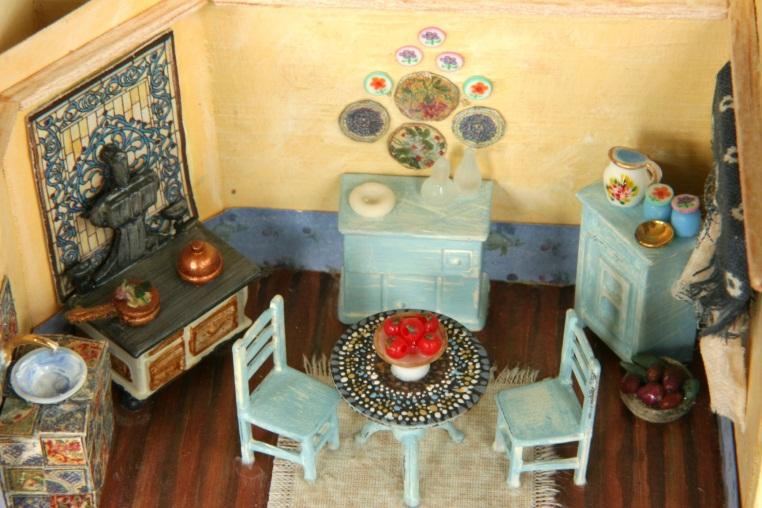
Same thing as with painting and sculpting. I love creating. In the miniature’s case, I can build entire micro-worlds and imagine all the stories taking place inside those universes. Quarter inch scale is my favorite, it allows you to build realistic miniatures, but with the added bonus of being compact and easy to display. To see my quarter inch scale project, go here.


6.) Besides being writers, we have something else in common. Beagles! Can you tell me about your love for these loud beasts

Beagles are the cutest, sweetest dogs. I wish we lived in the country so I could have as many beagles as I want, without neighbors complaining of the noise. What noise? Our furry babies used to go to Beagles Trials and chase rabbits, and it was such fun standing in a field with twenty/thirty of them, barking, bawling, and making a ruckus for every leaf falling on the ground. Good times. Since retired from field trials and having lost his brother, Nero, my remaining beagle, is now my writing companion; an ever-present shadow by my side. Whenever I feel a scene isn’t coming the way I want, I take five minutes of pet-therapy and everything is fine after that.

For more about Monica La Porta, check out her ...
Website: Monica La Porta's blog
Twitter feed